An enchanting lake
Attersee

An enchanting lake


We are not people of mountains and lakes. We prefer going to the coast and to rivers, where there is more movement. Still, every now and then you are tempted to go to a lake after all. When we heard about the Sommerfrische at the Attersee (cool summer retreats) of Gustav Klimt and Emilie Flöge, as a way to escape the heat of Vienna, that was a good reason to go there ourselves.

At the Attersee in Austria, you cannot avoid the famous painter Gustav Klimt (1863–1918). His bust stands in Unterach in the south. There is a Gustav Klimt themed trail: a walk along the northern shore of the lake, lined with large information panels about the painter. From 2012 to 2022 there was a Gustav Klimt Centre at the Attersee, but it has since closed. During our visit we come across Emilie Flöge Square, named after Gustav Klimt’s muse. She was, in fact, much more than just a muse: together with her sisters she ran her own fashion salon in Vienna. Not that you find much trace of that in Vienna, incidentally. It is interesting to find out why a park here at the Attersee has been named after her.

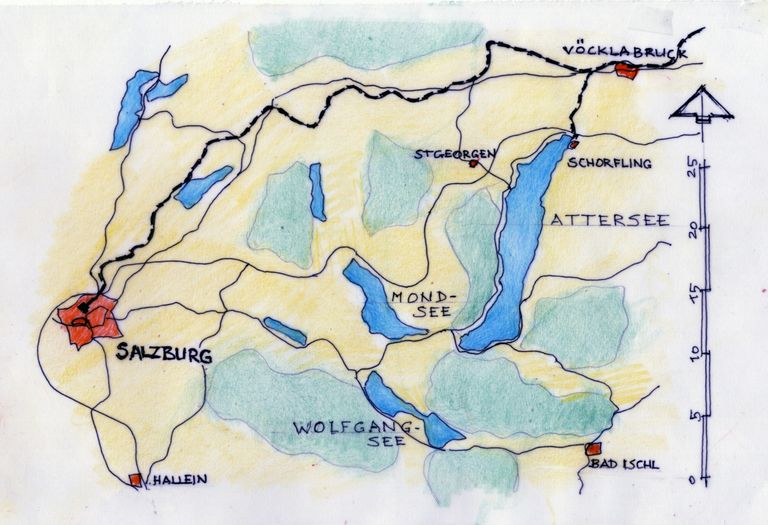
Map Attersee
Map Attersee

Emilie Flöge (1874–1952) was the fourth child of a Vienna-based manufacturer of meerschaum ‘smoking’ pipes. She had an older brother, Hermann (1863–1916), and two older sisters, Pauline (1866–1917) and Helene (1871–1936). Pauline was trained as a dressmaker and opened a private dressmaking school in 1895. She gave up that position when, in 1904, she opened a fashion salon together with her sisters at Mariahilfer Strasse 1b, associated with the Wiener Werkstätte (the Viennese Arts and Crafts movement). The fashion salon Schwestern Flöge produced handmade clothing for modern, wealthy (primarily Jewish) women in Vienna. At its peak, the salon employed 20 seamstresses, in addition to several home-based dressmakers. Helene married Ernst Klimt (1864–1892), Gustav Klimt’s younger brother, at the age of 20. Through this marriage, Emilie Flöge met Gustav Klimt. Ernst was a highly sought-after artist during his short life and worked alongside his brother and Franz Matsch. Between 1882 and 1892, the trio painted many ceilings in an historicist style in palaces and theatres. Ernst and Helene had a daughter, Helene ‘Lentschi’ Emilie Klimt (1892–1980). Because her father died within a year of her birth, Gustav became her guardian. Emilie was the designer and head seamstress of the salon and was responsible for purchasing the fabrics, often in France or England. In fact, the business was technically ‘illegal’ throughout its existence, since registration required the appointment of a male director. There was none, and Emilie refused to grant that position to someone merely for form’s sake.
For a long time, the prevailing view was that little was known about Emilie Flöge. Because of the Anschluss in 1938, the fashion salon was forced to close; all Jewish clients had fled. Together with her niece Lentschi, she continued in a small salon at Ungargasse 38. In 1945, both the home and the salon burned down, and the archives, both private and business-related, were lost. In 2014, the book Auf Freiheit zugeschnitten: Emilie Flöge, Modeschöpferin und Gefährtin Gustav Klimts by Marget Greiner was published. It is not a rigorously academic biography, but a pleasantly readable account of Emilie’s life. As a result, attention was finally drawn to her role as a fashion designer, rather than focusing solely on her relationship with Gustav Klimt. Emilie wanted to liberate Viennese women from the corset and preferred to design ‘reform’ dresses: dresses without a defined waist, offering the wearer great freedom of movement. She was closely connected to the Wiener Werkstätte. The fashion salon was designed by architect Josef Hoffmann and had a businesslike appearance, with clean lines and a black-and-white colour scheme. This was quite bold at a time when most people lived and worked in the Biedermeier style. She also drew inspiration from members of the Wiener Werkstätte, including the illustrations and jewellery of Koloman Moser (1868–1918). Gustav Klimt, in turn, was partly inspired by her fashion designs when depicting the clothing of the women he portrayed.

Gustav Klimt and Emilie Flöge on the Attersee  (batdress)
Gustav Klimt and Emilie Flöge on the Attersee (batdress)

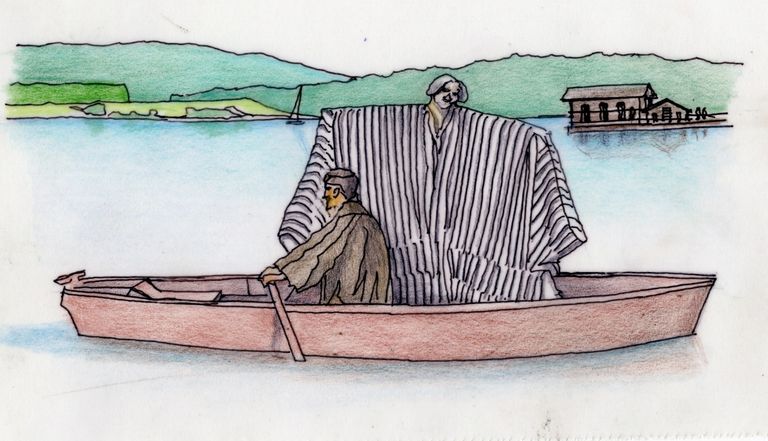
Her dream was to give Viennese women greater freedom. However, the reform dresses were a step too far for the conservative ladies of Vienna. She did succeed in introducing innovative elements into fashion. Her most extraordinary creations—worn only by herself—were photographed at the Attersee. There, Emilie felt free from the rules of Vienna. One of the most remarkable creations was the Fledermauskleid (‘bat dress’), shown in a photograph from 1908. The black-and-white pattern was presumably designed by Koloman Moser. The dress consisted of a single large piece of fabric almost four metres wide, with sleeves extending even beyond the length of her arms. She appears as if she could take flight at any moment. In the photograph in question, Gustav Klimt is standing beside her. At the Attersee, he always dressed in loose caftans sewn by Emilie.

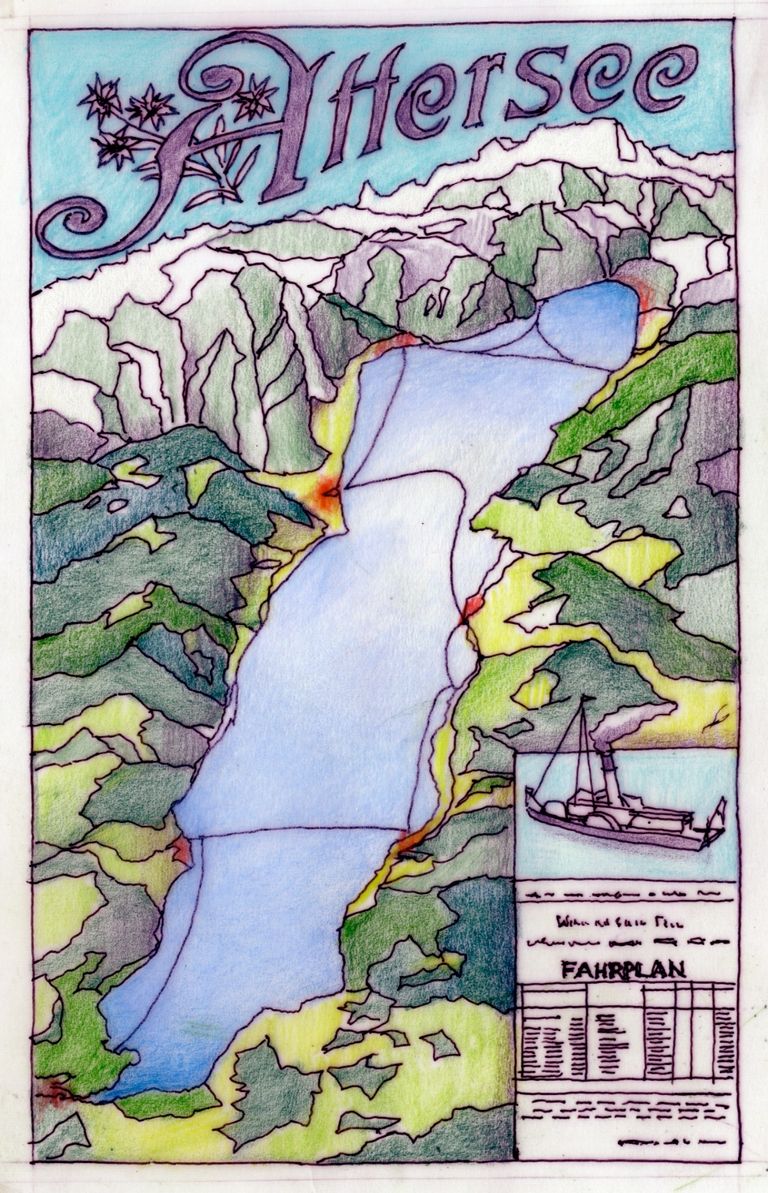
From 1901 onward, the Flöge sisters - often together with Gustav Klimt - spent their summers at the Attersee. Vienna was too hot in summer, and escaping to the lake brought cooling and relaxation. This was known as the Sommerfrische. Other lakes in the region were frequented by the aristocracy and the royal/imperial family. The Attersee became the destination of the urban bourgeoisie, artists, and intellectuals. It lies 60km east of Salzburg and 250km west of Vienna. The Attersee, also known as the Kammersee, is the largest lake in the Salzkammergut region of Austria. Salt was mined in this area in Roman times, which explains the name. The lake stretches 20km from north to south and 4km from east to west. It is not enclosed by mountains; in the north, the surrounding landscape is relatively low. The Höllengebirge mountain range, with its highest peak at 1,863m, lies on the southeastern side of the lake. On the northern side of the lake is Vöcklabruck, which has been accessible by train from Vienna since 1860 via the Empress Elisabeth Railway. In 1882, the Kammer-Schörfling station, located close to the lakeshore, was opened. This station was closed in 2014. The railway made the lake far more accessible for tourism; before that, travel depended on horse-drawn coaches. From 1913 onward, the Lokalbahn Vöcklabruck–Attersee railway line provided access to the western side of the lake.

Northern part of Attersee

In the lake lies a castle on an island, on the side of the village of Kammer. was first mentioned in 1260. It was built by the Schaunberger family on an island in the lake and was partly used as the administrative centre of the Attergau region. It was only accessible via a drawbridge. In 1383, it was sold to the Habsburgs. The castle remained in the possession of the noble von Khevenhüller family from 1581 to 1903. Between 1622 and 1642, the castle was expanded, and in 1710 it was renovated according to the plans of the Baroque architect Michael Prunner from Linz. In 1872, Countess Ida Horváth-Khevenhüller had the castle renovated and redecorated and commissioned the construction of four summer villas and the Hotel Kammer. A travel guide noted that 300 guests could be accommodated. In addition, the countess advocated for better connections for cars, trains, and ships. Together with her husband August Horvath von Szent Györg, the Countess founded the Attersee Shipping Company. All these investments eventually led to her bankruptcy, and the notary who settled her affairs received the four villas as payment. Due to modifications related to surrounding traffic, the castle gates in the north were demolished in 1938, and those in the south in 1971. The castle is still privately owned and cannot be visited.

Not only artists of the Wiener Werkstätte sought peace and inspiration at the Attersee. The Austrian composer Gustav Mahler (1860–1911) spent his summers in a small house in on the eastern shore to compose. He stayed there from 1893 to 1896. The ‘composer’s house,’ as it is now called, is a small museum next to a hotel. It is a one-room cottage where Mahler’s piano and several original documents are on display. From this house, Mahler had a magnificent view of the lake. At that time, he was the conductor at the city theatre in Hamburg. Parts of his Second and Third Symphonies were composed here. Through his wife, Alma Mahler (1879–1964), he had connections to the Wiener Werkstätte. She was the stepdaughter of the Secession painter Carl Moll (1861–1945). In 1901, Josef Hoffmann and Koloman Moser built a large double residence on the Hohenwarte in the 19th district of Vienna on Mahler’s commission. Mahler and Klimt could be considered kindred spirits. Mahler’s music caused as much of a sensation as Klimt’s paintings. Emilie Flöge attended a concert with Klimt that was conducted by Mahler himself in 1904 at the Vienna Court Opera, where the conservative audience jeered at the composer. She was also present at his farewell when, due to the antisemitic atmosphere in Vienna, he accepted a position at The Metropolitan Opera in New York at the end of 1907.

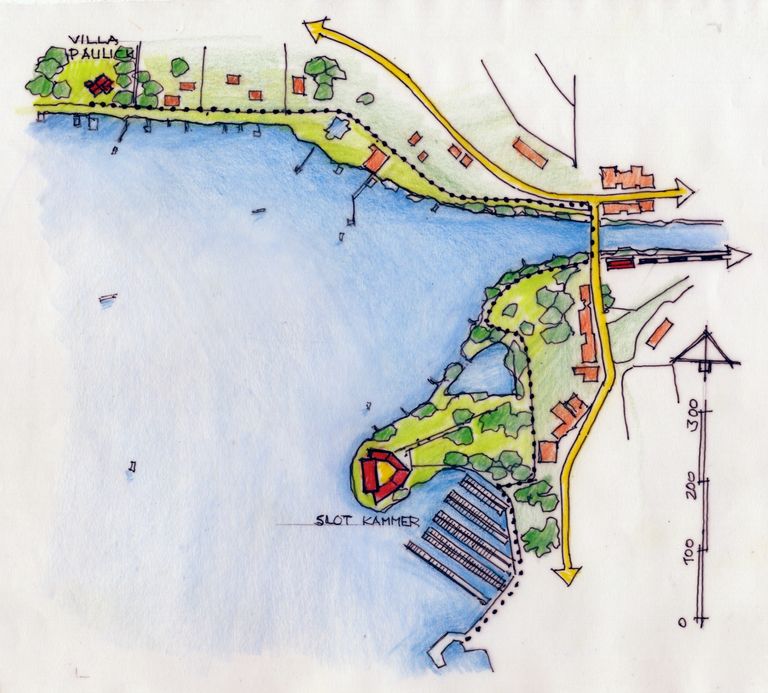
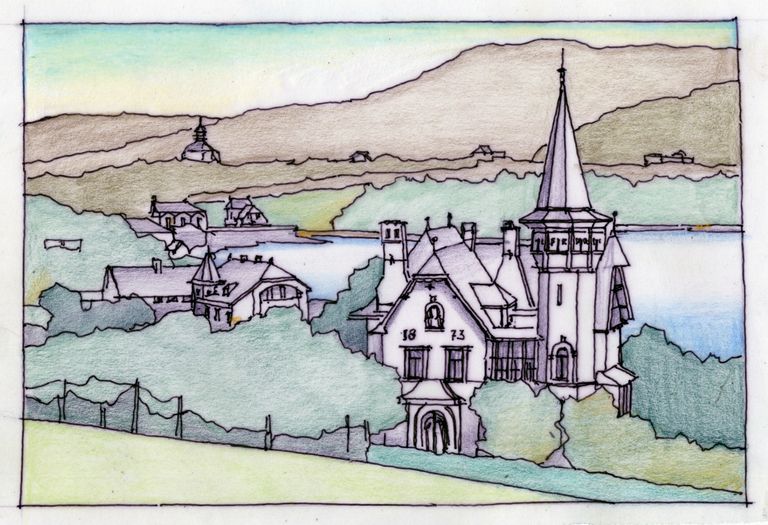
Klimt and the Flöges spent the summers from 1900 to 1907 in on the Attersee. There, Klimt stayed, thanks to his friend Paul Bacher, at the inn of the old brewery. The brewery operated from 1645 to 1930; unfortunately, nothing remains of it today. Paul Bacher was the first husband of Emma Paulick. She was a daughter of Friedrich Paulick, a Viennese master carpenter at the court of Emperor and King Franz Josef. Her sister Theresia was married to Emilie’s brother, Hermann Flöge. The Flöges spent part of their summer retreat at Villa Paulick, located at Seewalchen 83, now Promenade 12. Gustav Klimt was also a regular guest there. The villa is still privately owned. It was built in 1877, designed by Friedrich König and Rudolf Feldscharek from Vienna. From 1908, Klimt and the Flöges stayed at Villa Oleander, one of the four villas built near Schloss Kammer in 1872. It still exists and remains in private ownership. From 1914 to 1916, they moved to Villa Brauner in Steinbach. Klimt then chose a quieter location on the southern side of the lake, the forester’s house in Weissenbach.

Villa Paulick
Villa Paulick

is the village on the Attersee where most of the 19th-century villas can still be seen. Almost all the villas remain in private ownership. There is a good website where background information on the many villas can be found. As early as 1750, ‘Bäcker am See’ was built at Seewalchen 58, now Promenade 4, in chalet style by the Schmoller family. In 1904, the existing building was demolished and replaced by the ‘Lettmayr,’ designed by Matthias Aigner on commission from Wilhelm Deckert. The more elegant two-story house with a tower stood directly on the lake and had its own private jetty. In 1908, Deckert added a promenade and planted it with chestnut trees. From 1934, the house changed ownership and the tower was demolished. Since 1975, it has been known as the ‘Rosenvilla’.

At Seewalchen 78, now Atterseestrasse 53, is Villa Daheim. In 1872, Friedrich Otto Schmidt, an antique dealer from Vienna, built the villa. In 1895, his son Max took over the villa. Five years later, a guesthouse was added on the west side, which was named the ‘Schneckenvilla.’ After Max’s death in 1935, there was long uncertainty regarding the inheritance, and only in 1954, some 24 years later, did his nephew inherit the villa. In 1968, the villa passed to his underage son. In 1990, the villa was granted historic monument status due to both its distinctive exterior and interior—much to the chagrin of a company that had just purchased it to convert it into apartments. Later, an entrepreneur did succeed in fitting apartments into the villa while preserving its protected qualities.

At Seewalchen 99, now Atterseestrasse 67, stands Villa Schuh. The Viennese city council member and manufacturer Carl Schuh had this villa built in 1903. Sketches from 1901 by the architect Josef Plečnik (from the school of the famous Viennese architect Otto Wagner) laid the foundation for the villa, which was constructed in 1903 by master builder Franz Lösch from Schörfling. The son, Dr. Rudolf Schuh, became the resident. He ran a dental practice in the villa, was also a military physician, later a ship’s doctor, and wrote a book for the fire brigade. After his death in 1945, his widow and then daughter continued to live in the villa. In 1969, the villa came into the possession of another family. Due to bankruptcy in 1981, it was taken over by Bank Bregenz. In 1990, the villa was converted into exclusive apartments.

Although the villa no longer exists, it is worth mentioning the former Villa Chertek (also known as Villa Bäumler) at Atterseestrasse 69. In 1876, the director of the Prague Steelworks, Oberbergrath Ernst Bäumler, built a villa here according to plans by the Viennese architect Josef Wieser. It was one of the first villas in Seewalchen. The name Chertek came from its sale to Maria Brendler in 1894, who bequeathed it to her daughter Hannah, married to Edgar Chertek. He was head of forest management from 1908 to 1935 and became an honorary citizen. The family ran a guesthouse here until part of it was sold to a dentist in 1950. In 1963, the Gewerkschaft der Gemeindebediensteten der Stadt Wien (Union of Municipal Employees of the City of Vienna) acquired the property and built a spa with a swimming pool and bowling alley. From the early 20th century, it operated as a hotel with conference facilities. In 2006, a terrace was added and a lift installed to access the lower lake area and lawns. Since 2009, it has been known as Hotel Attersee. We had the pleasure of staying here with our Australian friend and editor of JE Reis.

Tourism at the Attersee flourished. Gustav Hasse built a lake and sunbathing facility on the site where his father-in-law had rented out boats, which became popularly known as the ‘Hasse-Bad.’ Later, ‘Villa Westen’ and two changing cabins were built on this spot. In 1957, a new beach bath (address Promenade 1a) was opened, featuring a large sunbathing lawn, 100 changing cabins, and a 10-metre-high diving board. A waterskiing school was also established. In 1996, the complex was renovated and reopened, now with slides. There is still a swimming pool at this location today.

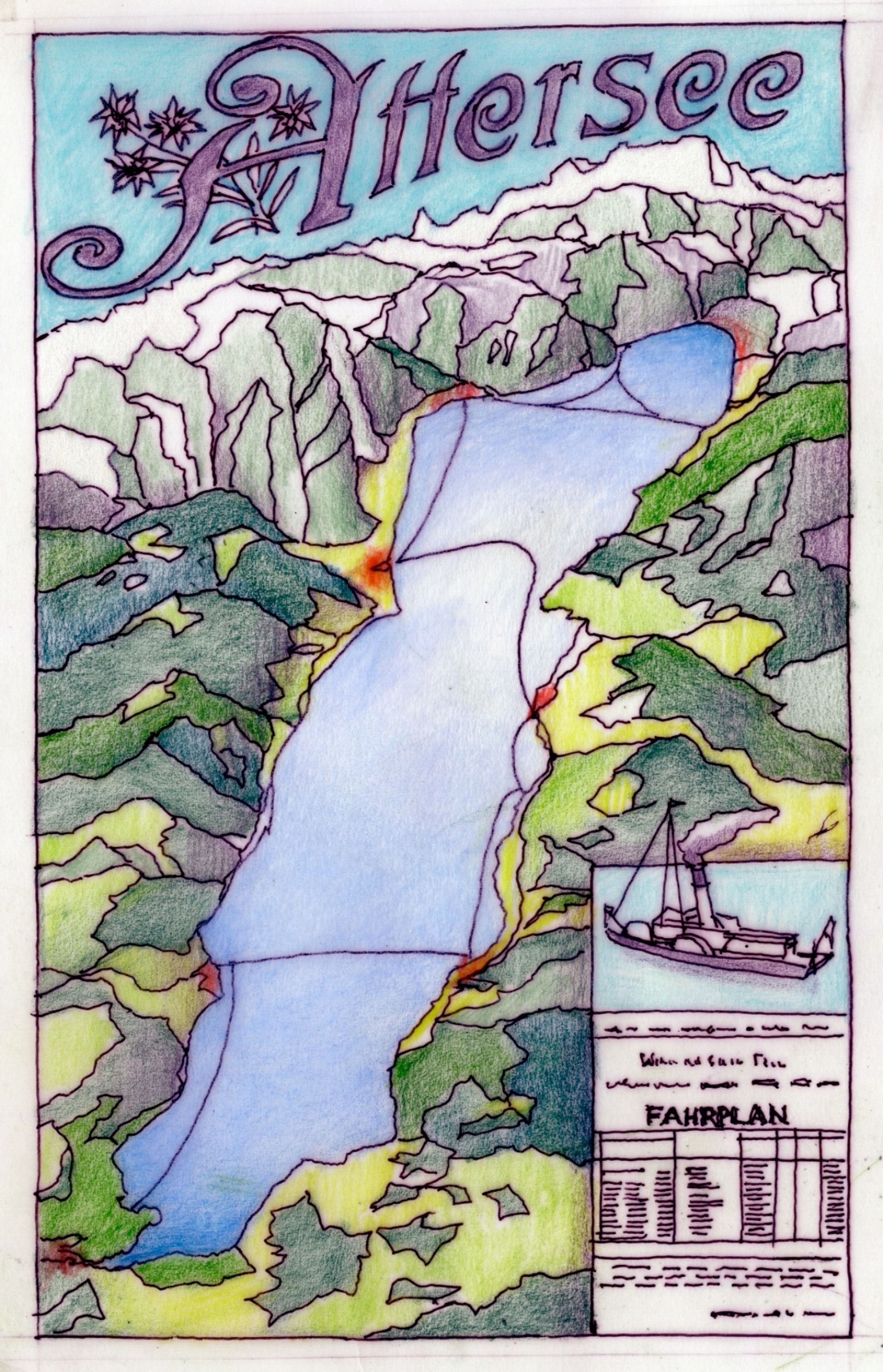
Poster Attersee
Poster Attersee

Now, you should know that we are more city, beach, and river people than mountain people. I also don’t like pine forests. Lakes in mountainous areas always make me think of jigsaw puzzles with 1000s of pieces, deep lakes reflecting the dark walls of the mountains. Through Klimt, we eventually arrived at a lake, the Attersee. To be honest, we fell in love with this lake. This is, of course, partly because the history of early tourism is still visible and tangible here. But it is also because of the lake itself. The colour of the Attersee is completely different from the surrounding lakes: it is turquoise. When you take a photo from the shore, people think you are at a seaside beach, not at a lake. One might assume that the light colour comes from the lake being shallow, but this glacier-formed lake is 170m deep. The colour comes from its location in an area of limestone and dolomite. Meltwater and rain dissolve fine limestone particles, known as ‘glacial flour.’ These microscopic particles remain suspended in the water and primarily reflect blue and green light, creating a bright turquoise effect. The water is low in nutrients, algae, and plankton, which keeps it crystal clear.

A Klimt by Jan
A Klimt by Jan

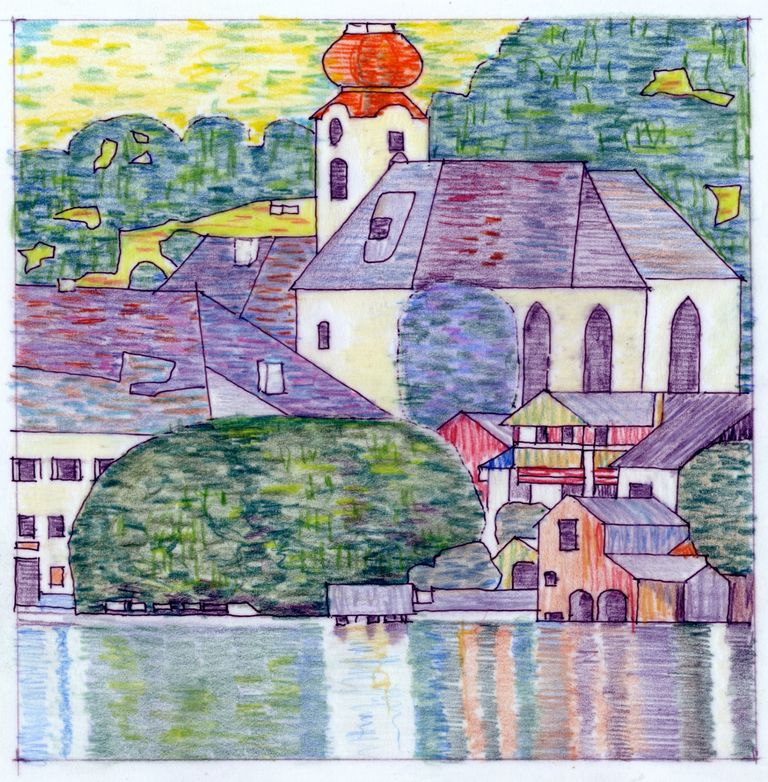
Klimt created 46 paintings at the Attersee. In the book Gustav Klimt: Summer Sojourns on the Attersee 1900–1916 by the Gustav Klimt Wien 1900 Foundation, a map shows exactly where each painting was made. These works are very different from the women’s portraits he produced in Vienna. They are primarily landscapes, with a few paintings of buildings along the lake. Here, he used what in English is called a viewfinder: a piece of cardboard with a square cutout. He would look through it at the distance to determine which scene within the square would make an interesting composition. All the paintings he made at the Attersee are therefore square, usually 100cm2 or 110cm2. In two of these paintings, Klimt captured the colour of the lake with remarkable accuracy. By placing the horizon very high on the canvas, nearly the entire painting is filled with sparkling shades of water.

Shortly thereafter, Hermann and Pauline, Emilie’s brother and sister, passed away, and Klimt himself died before the end of World War I. In 1936, her sister Helene Klimt-Flöge, Lentschi’s mother, passed away. Lentschi had been married to Dr. Rudolf Donner, who had died eight years earlier. She had trained in textile work and ornamental drawing at what we would now call the Academy of Fine Arts. Together with her aunt, she ran the fashion salon. In 1938, Emilie purchased a villa (built in 1928) in Weissenbach on the Attersee, where she spent summers with Lentschi. The villa provided the two women with a safe refuge during World War II. Emilie died in 1952 and left the villa to Lentschi (Helene Donner-Klimt).

Emilie Flögeplatz with bathing suit

For Emilie, the Sommerfrische at the Attersee was an opportunity to rest. Work in the fashion salon was intensive—she worked almost 12 hours a day. Not only did she create the designs, but she was also the one who attended to the clients. She understood what Viennese women wanted. Her designs were also very intricate, and she often put the finishing touches on the creations herself. She was extraordinarily athletic and enjoyed joining the men on mountain hikes around the lake. For this, she had even sewn trousers for herself, which made walking much more practical. She also rowed frequently with Klimt on the lake. In addition, she loved swimming and had designed and made her own swimsuit for the purpose.

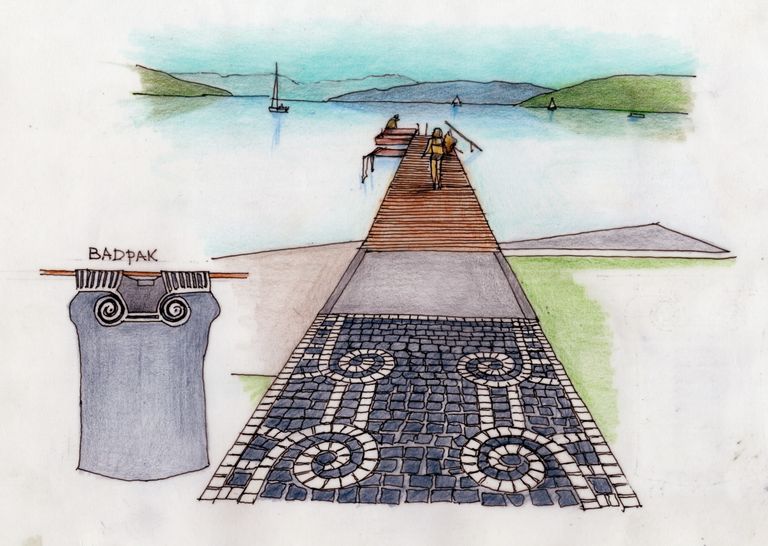
This brings us to Emilie Flögeplatz. It is located at the end of a public walking path along the lake shore at Seewalchen. What makes this small park so special is the paving. There is a path that leads to a pier with steps that allow direct access into the lake. The paving is in black and white and features a pattern based on a swimsuit Emilie designed in 1910. It is a black swimsuit trimmed with white piping. The piping ends on the left and right in elegant curls. The narrow straps are black with white piping on both sides, four on each side. This motif has been used in the paving. It is a very subtle tribute to a modern working woman and placed in the most fitting location.

2026

Share this article