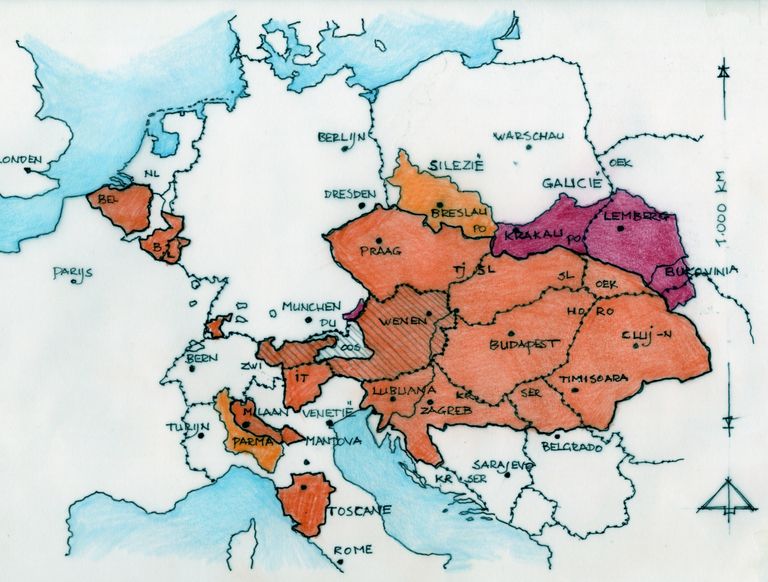
The Baroque period ended with the French Revolution in 1789, at which time the city had 207,000 inhabitants. In 1804, the Austrian Empire was established when Emperor Francis II declared himself hereditary emperor over the territories belonging to the Habsburg monarchy. Formally, he had ruled these territories only in a personal union. In 1805, Napoleon’s armies stood at the gates of Vienna. On August 6, 1806, he abdicated the (by then largely symbolic) imperial title of the Holy Roman Empire, partly out of fear that Napoleon Bonaparte might claim the title for himself. To secure the future of his empire, in 1810, Emperor Francis I married off his daughter Maria Louise Leopoldina Francisca Theresia Josepha Lucia of Habsburg-Lorraine (1791–1847) to Napoleon Bonaparte (1769–1821). She became his second wife. Since its founding, the empire had been the third-largest state in Europe, with 21.2 million inhabitants (in 1804), after Russia and France. At that time, it was a multinational state inhabited by various peoples: Austrians, Germans, Hungarians, Czechs, Romanians, Poles, Slovaks, Croats, Ruthenians, Italians, Roma, and Jews.