Legacy
Lisbon

Legacy


The famous places that tourists can most easily find are often very crowded. For us, it is always a challenge to look further…to search for less well-known places that are also worth visiting. In Lisbon, we found such a place at the Gulbenkian Museum and its garden. We asked several friends whether they knew of it, and it turned out they didn’t. More reason to share our experience with you!

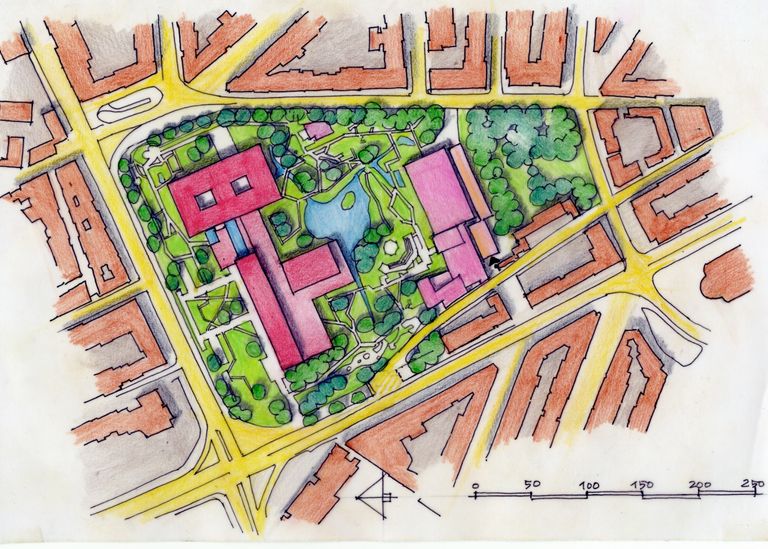
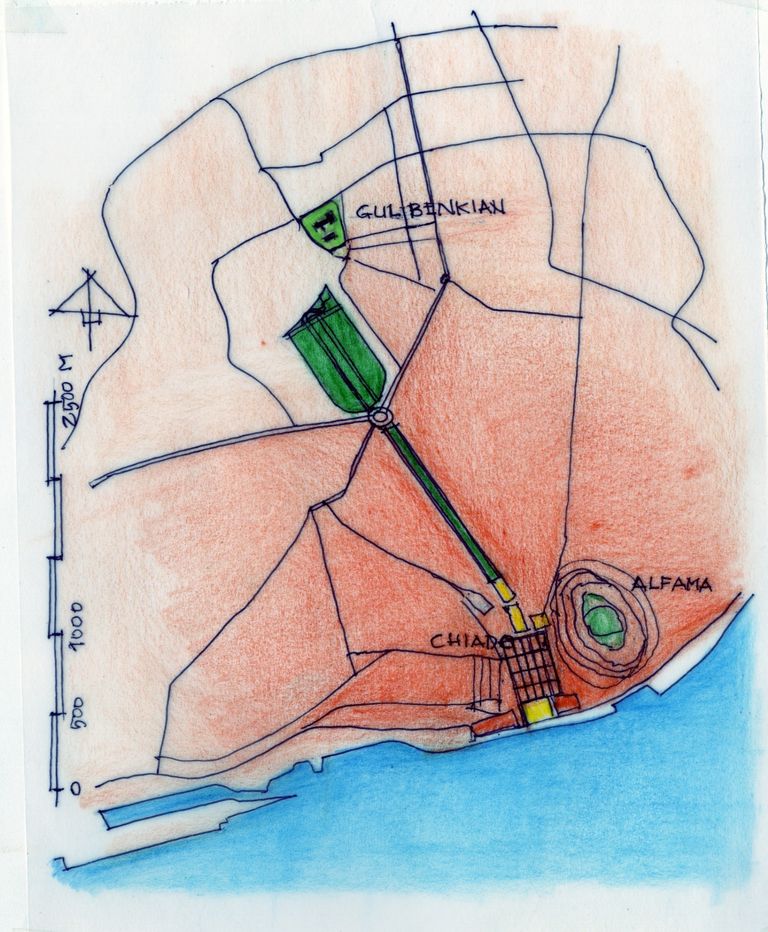
The Gulbenkian Museum, the Centre for Modern Art, and the accompanying garden are in the northern part of Lisbon.  They lie just north of Parque Eduardo VII and quite far from the city’s well-known tourist attractions, in the district of Palhavã. The entrance to the garden and the Centro de Arte Moderna José de Azeredo Perdigão (CAM for short) is on Avenida António Augusto de Aguiar. The Gulbenkian Museum itself can be reached via Avenida de Berna on the north side.

Map Lisbon
Map Lisbon

What struck us most about this place was the combination of garden, architecture, and art, and the fact that many city’s resident experience it as something quite natural. Jardim Gulbenkian - which we would probably call a park rather than a garden - can be closed off, but during the day it is open and freely accessible. We entered the grounds through the entrance to the Centre for Modern Art. Now, you should know that as architects, we tend to walk straight toward a building - perhaps take a quick lap around it - and then quickly look for the entrance. But here we were first drawn into the garden. This was due to the design of the entrance to the Centre for Modern Art, which flows very naturally into the garden. It even took our thoughts back to Brazil.

We travelled to Brazil in both 2002 and 2005. One of the things that stayed with us was the natural combination of architecture and garden or landscape. This was largely thanks to the work of landscape architect Roberto Burle Marx (1909-1994) and architect–urban planner Lúcio Costa (1902-1998). The latter was a supporter of Brazilian modernism and was responsible for the design of the new capital Brasília in 1956. Burle Marx is considered the father of modernist landscape architecture in Brazil. He was one of the first landscape architects to use native Brazilian plants in his projects. His work had a major global influence on the design of tropical gardens in the twentieth century. It is interesting that his influence even reached the regions of Brazil’s former coloniser, Portugal. This fusion of modern architecture and landscape is exactly what we recognised in Jardim Gulbenkian.

It is high time to now say something about Mr. Gulbenkian himself. Calouste Sarkis Gulbenkian (1869–1955) came from Scutari - now Üsküdar and today part of Istanbul. He studied engineering at King's College London. During his time in London, he also developed a strong interest in geology and applied physics. After his studies he became involved in the founding of Royal Dutch Shell company, where he was able to make good use of his knowledge of fossil fuels. In 1902 he became a naturalised British citizen. He helped establish several oil companies and accumulated his fortune as a shareholder. This role earned him his nickname: Mr. Five Percent.

He invested a lot of money in art, which he initially housed in a private museum in his home in Paris. When Germany occupied France in 1940, he fled with the French government to Vichy. In 1942 he moved to Lisbon, where he lived in the old Aviz Hotel until his death. He gave commissions to quite a few artists; also to René Lalique, an artist who worked with glass (who has a museum in Doesburg, the Netherlands). At the time of his death in 1955, Gulbenkian’s fortune was estimated at 840 million dollars, an enormous sum for that time. . After his death, his wealth was used to establish the charitable and cultural foundation known as the Calouste Gulbenkian Foundation.

The Calouste Gulbenkian Foundation serves as the umbrella for six different institutions: a museum, a centre for modern art, a garden, an art library, a music department, and an institute for advanced studies. The foundation began by organising a design competition for the construction of a museum to house the collection of its namesake and for the design of the surrounding park. The chosen location was the former park of a palace that had already been purchased in 1957, two years after Gulbenkian’s death. Architects Ruy Jervis d'Athouguia (1917-2006), Pedro Cid (1925), and Alberto Pessoa (1919-1985) won the competition with a large concrete building. The architects collaborated with landscape architects Gonçalo Ribeiro Telles (1922-2020) and Manuel de Azevedo Coutinho, who were commissioned in 1958 to revitalise the park. The park and the museum opened in 1969.

Plan of Jardim Gulbenkian

The 7.5 hectare site belonged to a farm on the edge of the city in the eighteenth and nineteenth centuries, and was known as the Quinta do Provedor dos Armazéns. The grounds included a building, orchard, vineyard, vegetable garden, and fields where grain was grown. In 1861 the site was purchased by Eugénio de Almeida, a government adviser. A neoclassical palace was built, and a large garden was laid out. The latter was designed by Jacob Weiss, a Swiss gardener trained in the French style. The park was named Santra Getrudes. After the owner’s death, his wife sold the park to a zoo, which remained there for ten years. During that time the park became a meeting place for residents. At the beginning of the twentieth century a horse-racing track was added, and in 1943 the site became the city’s fairground. People gathered here for music, theatre, dance, food, and drink. The Calouste Gulbenkian Foundation was very charmed by this location precisely because of this history, where nature, culture, and people had been meeting for so long. In their view, this tradition should continue.
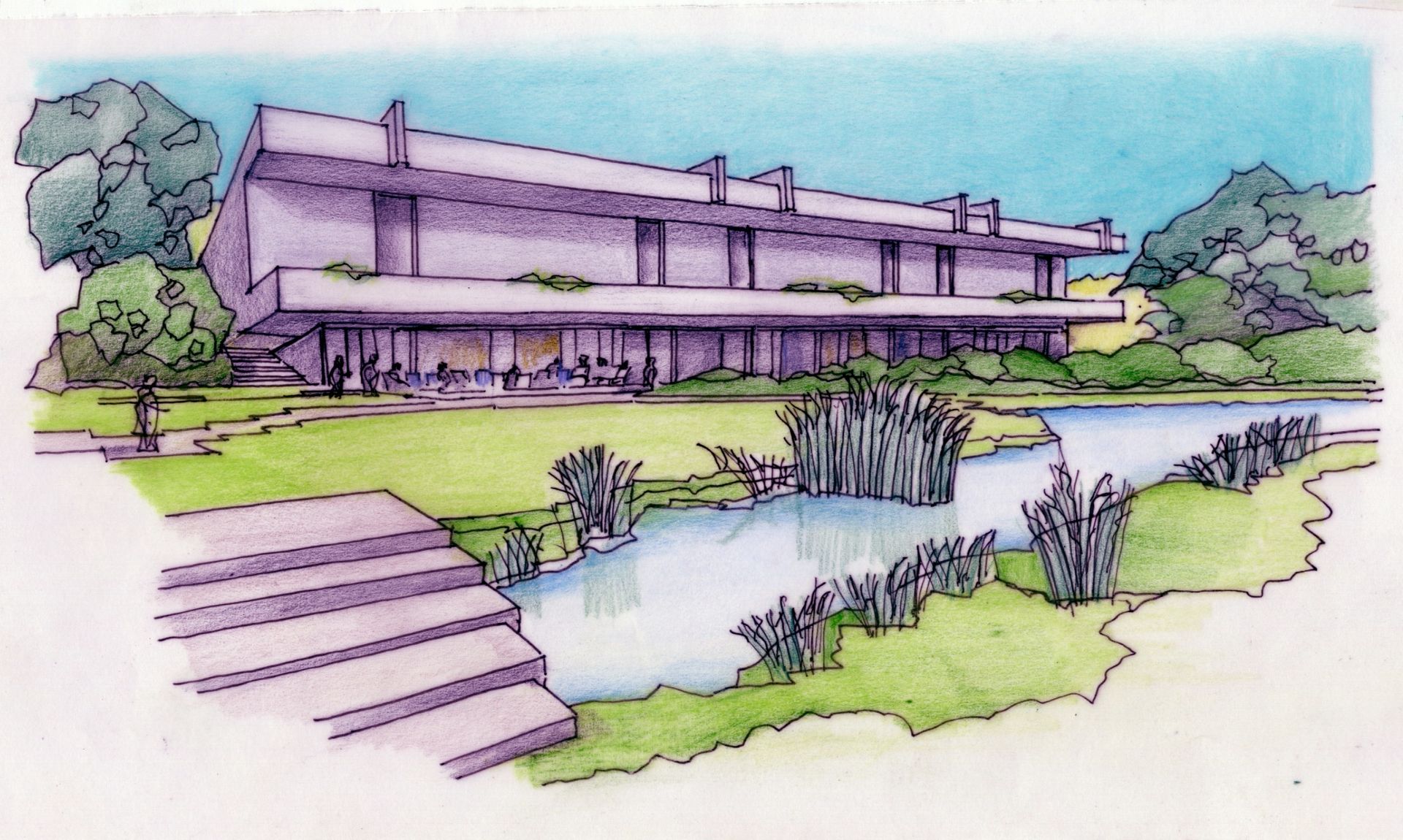
What we see today as the garden is no longer exactly the design from the 1960s. In 1975, partly due to Dutch elm disease and the construction of the Centre for Modern Art, an adaptation of the park became necessary. This redesign was created by António Viana Barreto (1924-2012). He increased the variation in landscape and planting within the park, introducing dense heterogeneous woodland areas as well as open spaces. In 2000, Gonçalo Ribeiro Telles, one of the original landscape architects, was asked to prepare a plan for the park’s revitalisation when certain parts had reached the end of their lifespan. This work was completed in 2012.

Originally the park had two large ponds; today there is one large natural pond and another pond directly beside the museum. The water flows feeding the pond have been made visible and are bordered by vegetated banks. The design of the park could be described as subtly geometric.’ Paths and bridges are made of linked large square concrete blocks. Changes in height are subtly incorporated into these blocks. You feel a bit like a child jumping from block to block, freely choosing which direction to go. Playfully you walk across the blocks through the grass, then through woodland, along waterside vegetation, and over the water. Benches and tables are arranged among the trees in the same playful way as concrete objects. The association with Brazil turns out not to be so strange when you look at the planting: eucalyptus trees, Brazilian pepper trees (Schinus terebinthifolia), and Pampas grass. In the garden, there is a large open-air amphitheatre with room for 1,000 visitors. A jazz music festival takes place here every first two weeks of August.

Garden, art and Centrum for Modern Art

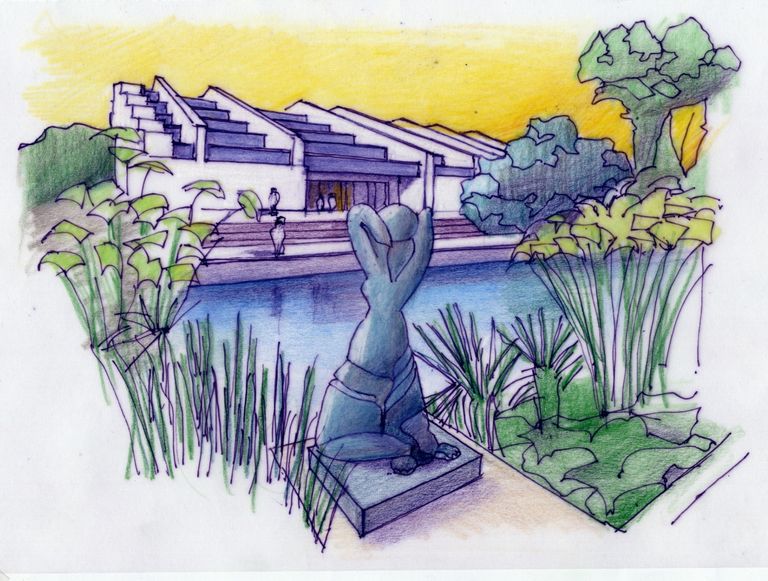
Various artworks are in the gardens in the vicinity of the buildings. There are many bronze sculptures, but also sculptures in other materials. One of the artworks stands out immediately because it fits so well with the architecture of the museum; it looks like a part of a house executed in concrete. The text accompanying the artwork reads: “Pedro Cabrita Reis, Monument in memory of Doutor José de Azeredo Perdigao, first president of the CS Gulbenkian Foundation on the 100th anniversary of Gulbenkian's birth, placed in 1997. For an idea that is constantly under construction, the idea of ​​a house that is under construction forever.”

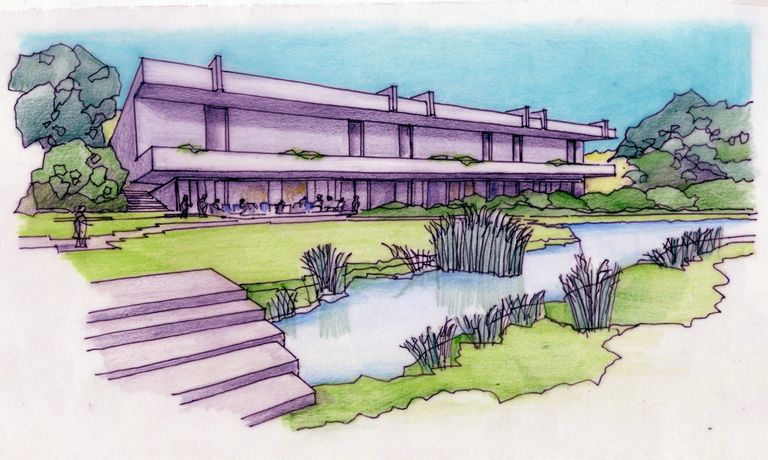
That artwork stands close to the museum. The large Brutalist building from the 1960s houses the foundation and the library in addition to the museum. Brutalism was an architectural movement from the 1950s to the 1980s characterised by raw, unfinished materials, particularly concrete (béton brut), and monumental geometric forms. Jan and I grew up with this movement, as the auditoriums of the universities in Delft and Eindhoven were built in this style. It therefore continues to fascinate us. The Gulbenkian Museum is a large concrete building with four storeys on the entrance side. You hardly perceive that height from the outside due to the heavy horizontal articulation. Moreover, the floor heights are low, and the top floor is set back somewhat. On the garden side, the building is well over two storeys high.

Gulbenkian museum
Gulbenkian museum

During our visit in late 2025, the building was undergoing renovation. Fortunately, part of the building was open with a temporary exhibition about – yes, indeed – Brazil. You enter an immense hall. Here, too, the comparison with modernist architecture in Brazil is evident. All those public buildings by the most famous Brazilian architect Oscar Niemeyer (1907-2012) are characterised by very large public spaces. We observe that the feeling this space evokes cannot be captured in a photograph or drawing. The staircases to the mezzanines are wide and gently sloping; there is room for large streams of people. The expansive walls offer space to display substantial works. Through large windows, you connect with the garden; the greenery seems almost to be inside.

From the website, we gather that there is a section with Oriental and antique art (a link to the Armenian heritage of the patron) and a section with European art. Here, the emphasis lies on applied art: art objects from the eleventh century to the mid-twentieth century. In addition, there is Renaissance art by Dutch, Flemish, French, and Italian masters, as well as painting from the eighteenth and nineteenth centuries.

Since the 1950s, the Calouste Gulbenkian Foundation has received important donations from artists, heirs, relatives, and collectors, such as Sonia Delaunay, the widow of Amadeo de Souza-Cardoso, the Henry Moore Foundation, and many others. This became a reason to consider establishing a centre for modern art. In 1983 this building—known as CAM—opened on the site. It was the first museum of its kind in Portugal. The museum building was designed by the English architect Leslie Martin (1908-2000) in collaboration with a Portuguese team. I must admit that I had never heard of this architect before.

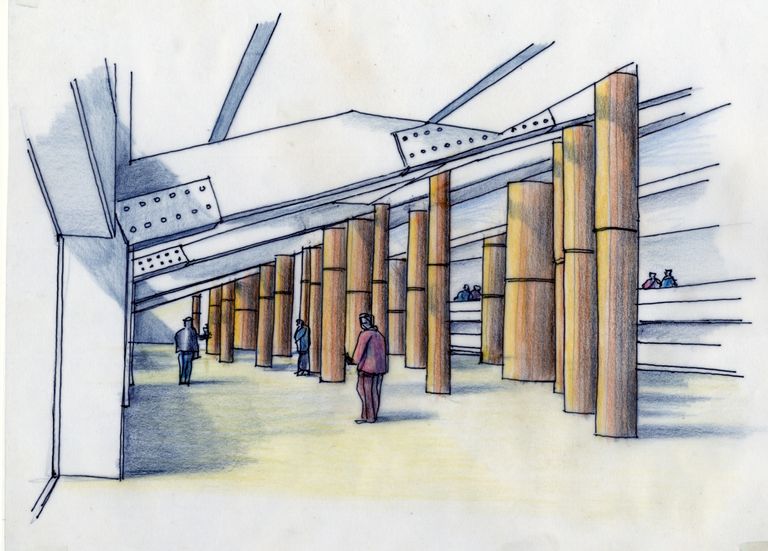
Interior of Modern Art Centrum

The building consists of two parts clad in light-coloured natural stone: one part on the street side and another on the park side. Both sections are connected by a transparent corridor that ensures you always maintain a view of the garden. This corridor - constructed with a black structural frame - is immediately used as exhibition space. You can simply walk through it on your way into the garden. The corridor gives access to the restaurant, the reception desk, and the galleries. The cloakroom and toilets are located on the basement level, where a very large seating bench has been installed. Via an elegant spiral staircase you look into a patio, allowing daylight to reach the basement as well.

The street-side section houses studios and teaching spaces. The large building volume on the park side is used for exhibitions. This section is divided into two parts: a tall exhibition hall (called the Nave) at the rear and smaller rooms on mezzanines and upper floors at the front. Through clever use of the difference in levels, you can look out through the windows of one of these rooms and see the feet of passersby outside. The variety in shape and size of the rooms makes it possible to display very different types and scales of art. In the large hall we encountered the ’forest’ by Carlos Bunga (1976): a forest of trunks more than five metres high made entirely of cardboard.

Canopy Modern Art Centrum

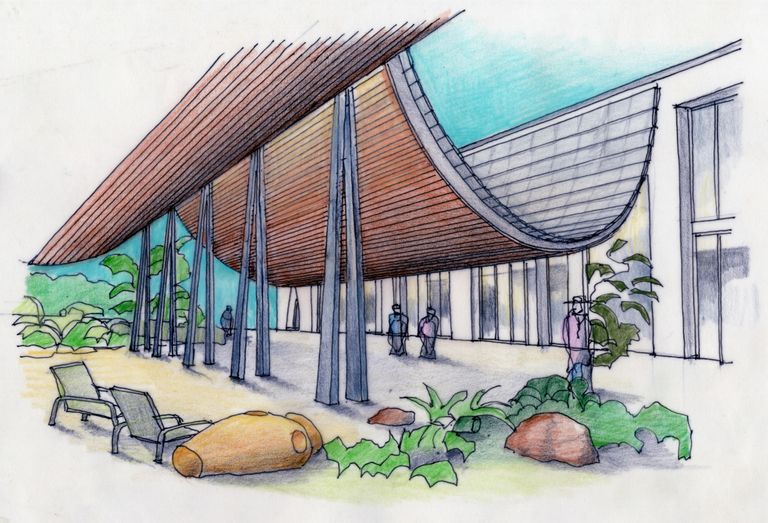
On 21 September 2024 the building was expanded and renovated. The Japanese architect Kengo Kuma(1954) was commissioned for the project. His task was to shape a more holistic relationship between landscape and architecture. In our opinion he succeeded remarkably well. The transition between building and garden is expressed through a large, suspended roof supported by wooden fork-shaped columns, marking the entrance to the building. The roof - a canopy - encloses an otherwise open space while offering protection from sun and rain. It feels like a place to meet, to stroll quietly back and forth. From here you can glance both into the museum and into the garden. The architect drew on the concept of engawa, a traditional Japanese veranda that mediates between house and garden. Because the veranda stands free from both the ground and the building, sufficient daylight can still reach the museum beneath the canopy.

This addition to the building was also a reason to adapt the garden again. For this project the Lebanese landscape architect Vladimir Djurovic was invited. He returned to the original principles of the designers from the 1960s by using only native plants, while also introducing elements inspired by the Japanese garden. The garden directly adjoining Kuma’s roof was opened, and winding paths were created leading to the more densely vegetated areas of the park. Loose chairs are placed throughout the garden so they can be used either outdoors or beneath the canopy. Once again, another layer has been added to make this place attractive for staying and meeting people.

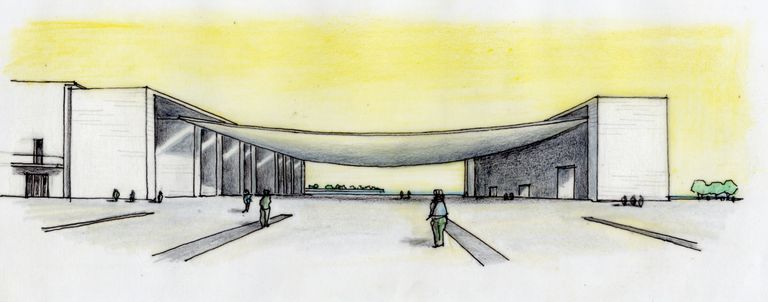
Our own association with the hanging roof of the CAM was not with Japan but with a Portuguese building a few kilometres away: the Pavilhão de Portugal, the Portuguese pavilion. In 1998 the World Expo took place in Lisbon at Parque das Nações along the Tagus River. The Portuguese pavilion was the main building on the Expo site. The entrance to this building lies beneath a large, suspended roof. The image the architect had in mind was that of a sheet of paper resting on two bricks. The roof formed an inviting gesture encouraging visitors to pass through this space on their way to the other pavilions. The design was created by the Portuguese architect Álvaro Siza Vieira (1933).

Portugese pavillon
Portugese pavillon

You can imagine that some people might hesitate to walk underneath it. The free span is 70 metres in length and 50 metres across. After the World Expo there was considerable debate about the future of the building. Many studies were conducted to find a new use. In 2015 the building was transferred to a university, which from that moment became responsible for its maintenance. Today it contains an auditorium with 600 seats, exhibition spaces, meeting rooms, and a restaurant. The Expo site itself is still worth visiting. Many of the buildings remain in use, new ones have been added, the public spaces are pleasant, and the cable car is still operating. The area is easily reached via Gare do Oriente, the railway station, designed by the Spanish architect Santiago Calatrava (1951).

Back to Jardim Gulbenkian. What a remarkable and layered history this place in the city has. How an Armenian became a multimillionaire in England, turned his back on that country after the war, and emigrated to Portugal - where he further developed his role as a patron of the arts with an extraordinary legacy of money, art, and a place where nature, culture, and people come together. Over time adjustments were repeatedly made to the greenery and the buildings, yet the original identity was never abandoned; instead, it was carefully built upon.

We do the best we can to give an impression of it, but honesty compels us to say that there is really only one way to experience it—and that is to go there.

“I am somewhat of a dreamer and in my early youth was destined to follow the study of astronomy, but my father put me into business … However, I still like to look for distant horizons and conceptions.”
Calouste Sarkis Gulbenkian

2026

Share this article